High-performance race vehicles demand every possible advantage, with even small improvements in shift speed and power delivery translating directly into faster lap times. One key technology that enables this is the gearshift loadcell, used to provide a repeatable, precise and reliable trigger for control systems.
In a manual gear change, the driver must lift off the throttle and disengage the clutch before selecting the next gear. This interrupts torque delivery to the wheels, reducing acceleration and increasing lap time. Whether using a H pattern gearbox or a sequential transmission, accurately measuring the moment a driver initiates a shift is key to minimising shift times.
By contrast, a gearshift load cell enables full-throttle, clutchless shifting. When the driver applies force to the gear lever, the load cell detects this input instantly and signals this to the vehicles ECU. The control system then briefly reduces engine torque, typically for only a few tens of milliseconds, allowing the next gear to engage without requiring throttle lift or clutch use.
Key Benefits:
- Maintains near-continuous torque to the drivetrain
- Reduces shift time significantly
- Improves overall vehicle acceleration
- Reduces time lost during each gear change
- Simplified driver inputs
Reduced Driver Workload and Increased Consistency
By eliminating the need to coordinate throttle lift, clutch operation and gear shift, a gearshift load cell simplifies the shifting process. This frees up driver attention to focus on racing lines, vehicle rotation and braking.
Benefits to the driver:
- Reduced cognitive and physical load
- More repeatable shifts
- More consistent performance from lower fatigue levels
Reduced Powertrain Wear
A refined control system using a load cell as a trigger helps reduce the wear on all components by ensuring smooth shifts through rev matching on downshifts and power cuts on upshifts.
Without proper unloading:
- More wear on dogs
- Harsher gear engagement
With load cell control:
- Torque reduction is precisely timed
- Engagement loads are reduced
- Gearbox life can be extended
Hardware and Installation
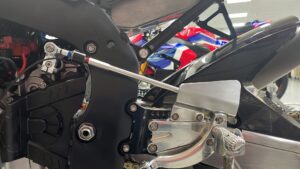
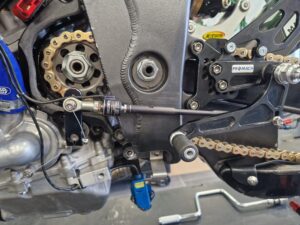
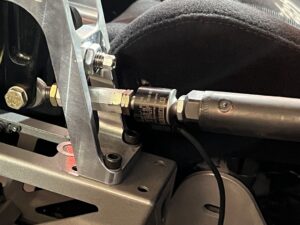
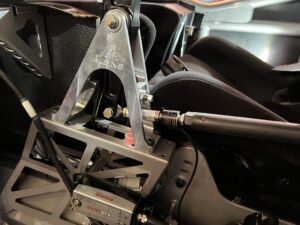
We offer two primary configurations: inline (GSS) and lever mounted (GST)
Inline (GSS)
- Installed in the gear linkage
- Measures tension and compression forces directly
- Multiple thread options available
- Easy to design in
Gear Lever (GST)
- Mounted at the top of the gear lever with a range of gear knobs available.
- Easier to install where linkage access is limited
- Suitable for retrofit applications
Conclusion
A gearshift load cell is a critical component in modern high-performance powertrain control. By allowing the ECU to detect driver intent and apply precisely timed torque management, it delivers:
- Faster, clutchless full-throttle shifts
- Improved acceleration and torque continuity
- Enhanced shift quality and consistency
- Reduced driver workload
- Potentially increased drivetrain longevity
When properly integrated and calibrated, a gearshift load cell becomes a key component in extracting maximum performance from a race vehicle powertrain.
Click here to return to the Automotive and Motorsport Page